Nature’s secret glow
I love spending time with large groups of biologists. They are the nicest people (no personal bias here whatsoever!) and as an added bonus, one can learn the most fascinating things in their company. Recently I attended a conservation conference and had my mind blown on a number of occasions, not least during an incidental discussion over lunch on biofluorescence.
Many of you will be familiar with the ghostly blue-green glow of a scorpion under UV light. Our guides have pointed this out many times to viewers over the years. Some of you may even be aware of the otherworldly glow of certain fungi at night or the eerie sparkle along coastlines caused by microscopic plankton species. These three examples, though, are actually two very different processes. The better understood bioluminescence is the ability of a creature, such as certain fungi and plankton, as well as fireflies, glow-worms and anglerfish, to produce its own light through a chemical reaction. It is not the same as biofluorescence, which is less well studied and even less well understood. Biofluorescence is the ability of fur, skin or other body parts to absorb ultraviolet (UV) light and re-emit it as a visible colour, as in the example of the scorpion under UV light. A biofluorescent animal needs an outside light source (usually UV or blue light) before its hidden colours appear.
While humans have known about bioluminescence for thousands of years, biofluorescence was only discovered in the 1920s in species like moths and butterflies and was first reported in scorpions in the 1950s. For many years, biofluorescence was believed to be a rare quirk of nature. But over the last 15 years or so, interest in this odd trait has intensified as advanced blue light cameras and portable UV and black light technology have revealed that biofluorescence is literally everywhere if you know how to look for it!
Marine biologists using new technology have recently discovered hundreds of glowing reef fish, sharks and even turtles. But a very surprising development came around the same time, when a scientist was searching an Australian rainforest for glowing mushrooms. She was astonished to see a small, mouse-like marsupial called an antechinus shine bright white under a UV torch, despite its fur appearing soft brown in ordinary light. The sight was so unexpected that the researcher briefly wondered whether she was hallucinating after touching some psychedelic mushrooms. Perhaps she had licked her fingers… But the glow was real, thus adding the antechinus to a growing list of biofluorescent mammals that includes flying squirrels, wombats and ghost bats.
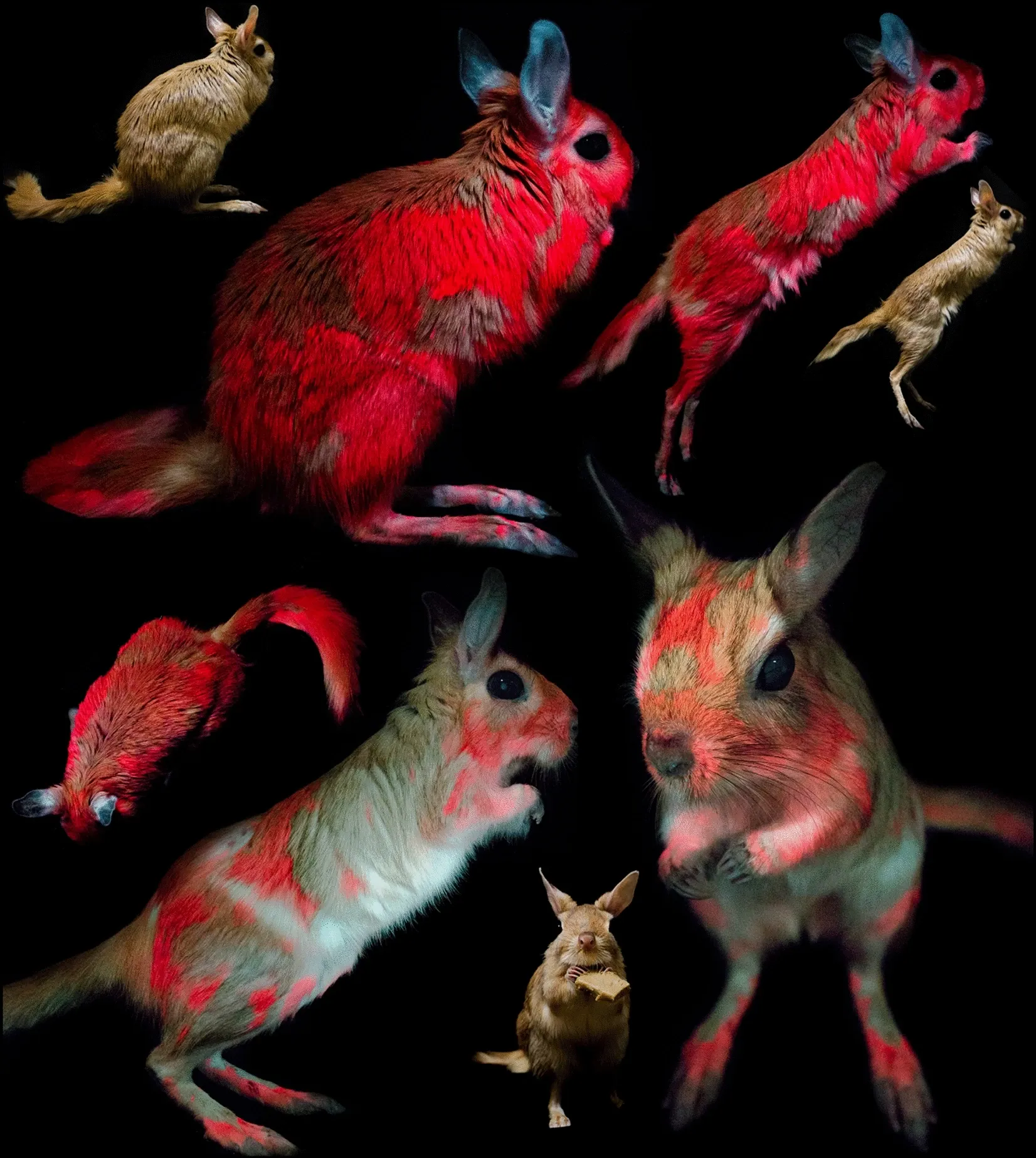
Astonishingly, African springhares happen to be one of these mammals. In ordinary light, a springhare’s coat looks sandy brown. Shine UV light on it, however, and patches and swirls of vivid pink and orange can appear across its fur. Springhares already look like an unlikely mix of rabbit and kangaroo, so their secret glow adds another remarkable detail to this unusual nocturnal African animal.
Their colour is linked to organic compounds called porphyrins in the fur. The glow can appear patchy rather than even, creating a pattern that looks almost painted on. Because springhares are active at night, the discovery has raised an intriguing question: can they—or the predators and other animals around them—see these fluorescent markings without the help of a human UV torch?
Springhares are not alone. Under UV light, flying squirrels can glow pink or magenta, platypuses blue-green, and some other Australian mammals—including wombats, bandicoots, echidnas and Tasmanian devils—show colours ranging from bright white to blue and pink. Fluorescence has also been recorded in birds, reptiles, amphibians, fish and many invertebrates, suggesting that nature is far more colourful than limited human eyesight reveals.
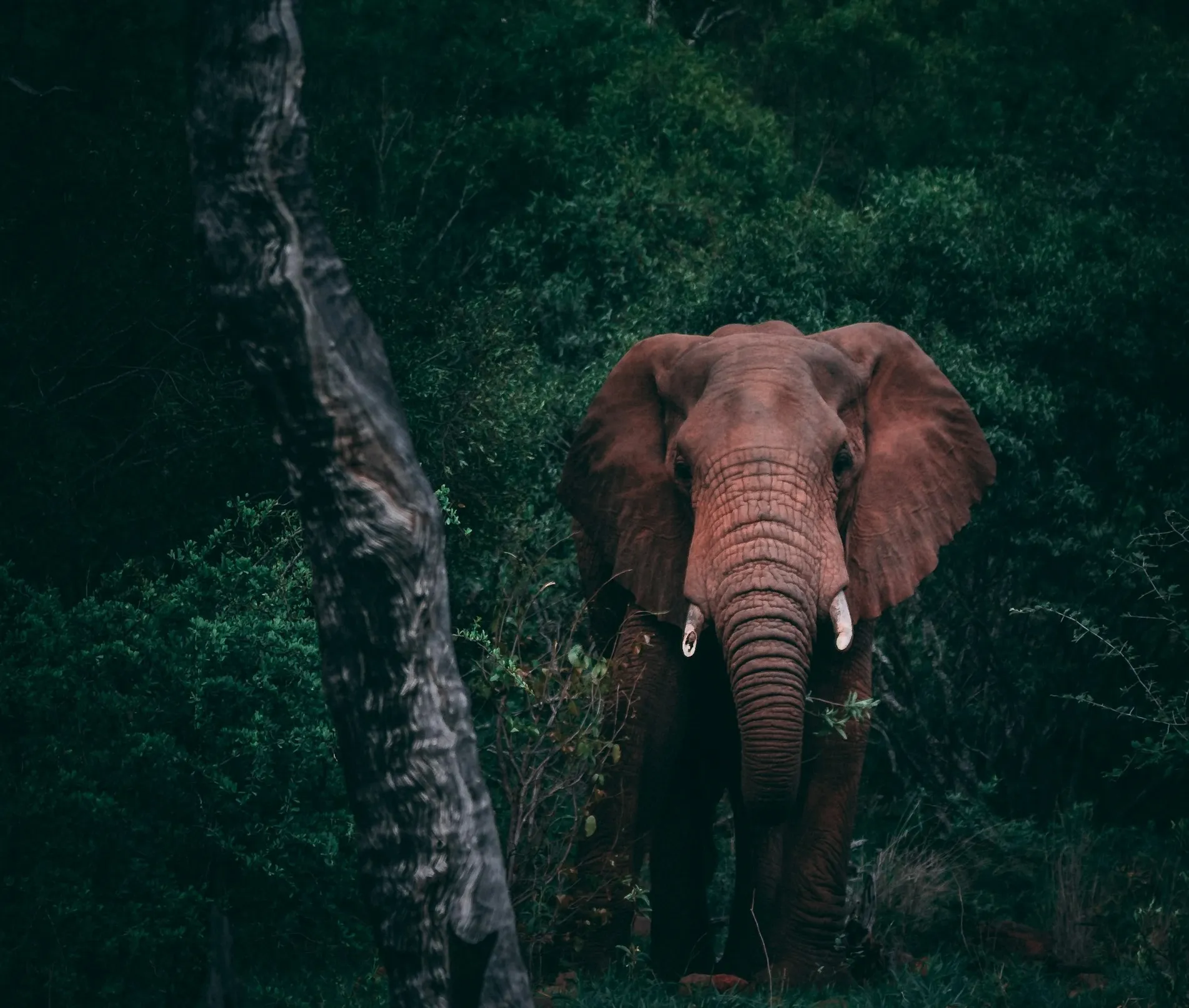
Intriguingly, biofluorescence is not restricted to small mammals, although it was originally believed to be. It has now been discovered in large mammals including zebras and apex predators like polar bears. It has even been reported in big cats like lions and leopards. How remarkable! In all my years of watching these big cats after dark, I had no idea what my eyes were missing! In all the above examples it is the lighter parts of the coat that glow, as melanin (the pigment responsible for the darker stripes on a zebra and the dark rosettes on a leopard) absorbs UV light rather than re-emitting it.
So why would a springhare, or any other animal for that matter, glow? Researchers are still working that out. The science is in its infancy and at the moment there are far more questions than answers! The fluorescence might help animals recognise or signal to one another in low light, although many scientists argue that olfactory (the sense of smell) cues should be sufficient for this purpose. Perhaps biofluorescence provides camouflage by breaking up the animal’s outline or creating visual “noise” for predators that can detect UV. The porphyrins might also be waste products deposited in the fur, perhaps helping the body remove certain compounds. And there is a simpler possibility: the glow may have no special function at all. It may just be an accidental side effect of the chemistry of fur. For now, these species keep their fluorescent secrets… and remind us that even familiar-looking wildlife may be hiding colours we have yet to discover.
References
Olson, E. R., Carlson, M. R., Ramanujam, V. S., Sears, L., Anthony, S. E., Anich, P. S., ... & Martin, J. G. (2021). Vivid biofluorescence discovered in the nocturnal Springhare (Pedetidae). Scientific Reports, 11(1), 4125.
Reinhold, L. (2020). Fluorescent forests: of mushrooms and marsupials. The Queensland Mycologist, 15(1/2), 5–12.
Reinhold, L. (2021). Mammals with fluorescent fur: observations from the Wet Tropics. North Queensland Naturalist, 51, 1–8.
Travouillon, K. J., Cooper, C., Bouzin, J. T., Umbrello, L. S., & Lewis, S. W. (2023). All-a-glow: spectral characteristics confirm widespread fluorescence for mammals. Royal Society Open Science, 10(10), 230325.