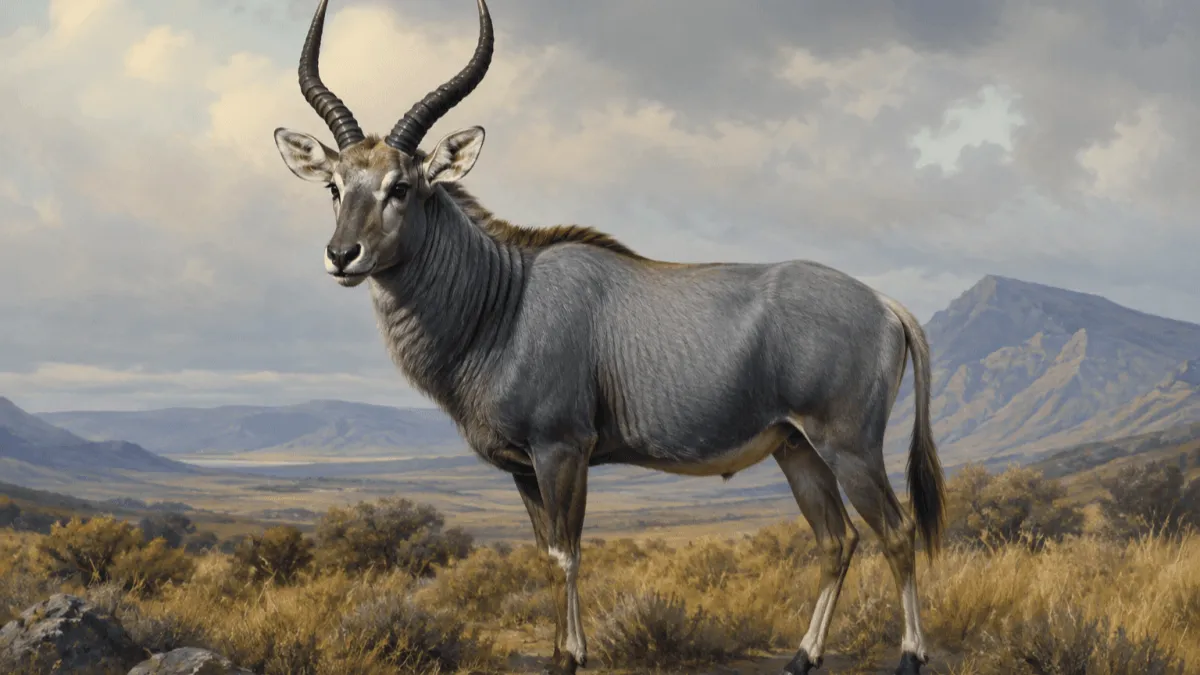
The bluebuck, or Hippotragus leucophaeus, was a large antelope that once lived in the grasslands of what are now South Africa’s Western and Eastern Cape. Related to the roan and sable antelope, it was said to have had a bluish-grey coat and striking horns. Yet by around 1800 it had disappeared, probably because of a combination of hunting, habitat transformation and wider pressures linked to colonial expansion. Recently there has been a lot of press around a proposed attempt to bring the species back from extinction. This raises one of the most fascinating questions in modern conservation: if science gives humanity the power to recreate something like an extinct animal, should that power be used?
What makes the bluebuck especially intriguing is not only that it became extinct, but that it did so before scientists had properly studied it. As a result, relatively little is known about its behaviour, social structure, ecological role or variation within the species. This lack of knowledge complicates any attempt to recreate it. A modern biotechnology company might be able to recover genetic material from preserved museum specimens, but DNA alone cannot recreate every feature of a vanished animal or the world in which it lived.
In April 2026, an American company, Colossal Biosciences, announced work on a bluebuck “de-extinction” project, reportedly begun in 2024. The proposed process is not simple cloning, because no living bluebuck cells exist. Instead, researchers would compare bluebuck DNA with that of living relatives, especially the roan antelope, identify important genetic differences, edit living antelope cells and use those cells to create embryos. These embryos would then be implanted into surrogate roan antelope mothers. If successful, the result would not be an original bluebuck brought back unchanged after two centuries, but a genetically engineered animal designed to resemble the extinct species.
This distinction is central to the debate. The IUCN Species Survival Commission prefers the term “proxy” rather than “de-extinct species”, because present-day technology cannot produce a perfect replica of an extinct animal. A species is more than a sequence of DNA. It is also shaped by development in the womb, maternal effects, epigenetics, learned behaviour, social relationships, microbiomes, population genetics and ecological interactions. Therefore, even a successful bluebuck project would create a bluebuck-like proxy, not a time-travelled original.
Supporters argue that this still makes the project worthwhile. One powerful argument is moral: humans contributed to the bluebuck’s extinction, so humans may have a responsibility to repair some of that damage if they can. From this point of view, de-extinction is not merely a technological stunt, but a form of restoration. If human activity helped destroy biodiversity, then perhaps human technology can help restore at least part of what was lost.
A second argument is practical. The technologies required to create a bluebuck proxy—genome sequencing, genome editing, stem-cell techniques, embryo manipulation, antelope IVF and artificial reproduction—could also benefit living endangered species. Even if the bluebuck itself is never successfully recreated, the research might produce tools that help prevent other antelopes from disappearing. In this sense, the project could have conservation value beyond the extinct animal that inspired it.
There is also an ecological argument. If the bluebuck once played a distinctive grazing role in the Cape ecosystem, a carefully designed proxy might restore some of that lost function. This is probably the strongest conservation-based justification for de-extinction: not simply to display an unusual animal in captivity, but to recover an ecological role that disappeared with the original species. However, this claim depends on whether the proxy would genuinely behave like the bluebuck and whether there is still suitable habitat for it.
The objections, however, are substantial. The first is practical: where would these animals live? The Cape landscapes of 200 or 300 years ago no longer exist in the same form. Agriculture, urbanisation, fencing, invasive species, climate change and other human pressures have transformed the region. Even if scientists produced several bluebuck-like animals, questions would remain about their diet, territory, predators, competitors and social behaviour. Because the original species vanished before modern ecological research could study it properly, many of these questions cannot be answered with confidence.
A second problem concerns genetics. Recovering a genome from museum specimens does not recover the full genetic diversity of a species. A living population contains variation, adaptation and evolutionary history that cannot be captured by one or a few preserved samples. Moreover, if scientists begin with the genome of a living relative and edit it to express bluebuck-like features, they must decide which traits matter most. At what point does such an animal become a bluebuck rather than a new genetically engineered antelope? This question is scientific, but it is also philosophical.
Animal welfare is another serious concern. Before a viable animal is born, there may be failed embryos, unsuccessful pregnancies, developmental abnormalities, unsuccessful gene edits and invasive procedures involving surrogate mothers. The ethical cost of de-extinction therefore cannot be measured only by the final success. It must also include the experimental process required to get there. This is especially important because the bluebuck is already extinct; the procedures would not be rescuing living bluebucks from immediate danger.
Perhaps the strongest criticism from traditional conservationists is the opportunity-cost argument. Money, expertise and public attention are limited. If large amounts of funding are spent trying to reconstruct an extinct antelope, those same resources might not be available for protecting habitats, combating poaching, restoring ecosystems or supporting breeding programmes for species that are still alive. In this view, preventing extinction should matter more than attempting to reverse it after the fact.
There is also a psychological danger. Conservation messaging has long emphasised that extinction is permanent. If the public begins to believe that lost species can simply be brought back, extinction may start to seem less serious. In reality, producing a partial genetic proxy would not make extinction truly reversible, but the impression created by high-profile de-extinction projects could still weaken the urgency of protecting living species.
The bluebuck case also raises important governance questions. Once scientists can design organisms to resemble extinct species, society must decide who controls that power. Should private companies own the technologies involved? Who decides which species deserve to be recreated? Who is responsible if an engineered animal causes ecological harm? These questions become even more significant because the bluebuck belonged to South Africa, and its extinction is tied to the history of the Cape. Any future release would need to involve South African scientists, conservation authorities, landowners, local communities and possibly Indigenous stakeholders. The question should not only be whether biotechnology can create a bluebuck proxy, but whether South Africa wants such an animal returned, and under what conditions.
There is, therefore, no simple answer. Scientifically, the project is legitimate in the sense that researchers may be able to recover substantial bluebuck DNA and produce an animal with bluebuck-like characteristics. However, it would be misleading to say that the original bluebuck species could be recreated exactly. Technical success is not the same as conservation success. A biotechnology breakthrough may produce an animal that resembles the bluebuck, but that does not necessarily mean it can restore the original Cape ecosystem or establish a self-sustaining wild population.
In the end, the bluebuck debate brings together three different questions: can we do it, would it benefit biodiversity, and should we do it? The first question is scientific; the second is ecological; the third is ethical. A cautious position may therefore be best. De-extinction should not be dismissed as fantasy, because it may produce useful tools for conservation. However, it should not be celebrated uncritically either. If a bluebuck proxy is ever created, it should be judged not by how impressive the technology is, but by whether it benefits living ecosystems, respects animal welfare, involves the people and places connected to the species, and does not distract from the urgent task of protecting the species that still remain.
References
Animal Diversity Web. 2014. Hippotragus leucophaeus blue buck. Available at: https://animaldiversity.org/accounts/Hippotragus_leucophaeus/
Themudo, G.E. and Campos, P.F. 2017. Phylogenetic position of the extinct blue antelope, Hippotragus leucophaeus, based on complete mitochondrial genomes. Zoological Journal of the Linnean Society.
IUCN Species Survival Commission. 2016. IUCN SSC guiding principles on creating proxies of extinct species for conservation benefit, version 1.0. Gland: IUCN Species Survival Commission. Available at: https://portals.iucn.org/library/node/46248
Colossal Biosciences. 2026. Colossal Biosciences is bringing back the bluebuck antelope. Available at: https://colossal.com/colossal-biosciences-bluebuck-antelope-de-extinction/