The sky's first hint of spring
I always spend the first two weeks of August scanning the skies.
Everywhere I go, I find myself glancing up at the boundless sky in hopeful excitement.
For me, it usually happens around the 15th of August. Every year, for the last 40 or so, it has happened a few days before or a few days after that date.
The return
I will be driving somewhere when a quick, darting form in the heavens above causes me to brake suddenly and gaze upward in wishful anticipation. I even have a bumper sticker on my car to warn those travelling behind me of this eventuality. I'm very thoughtful that way. It says, “Birdwatchers!! Prone to Sudden Stops!”
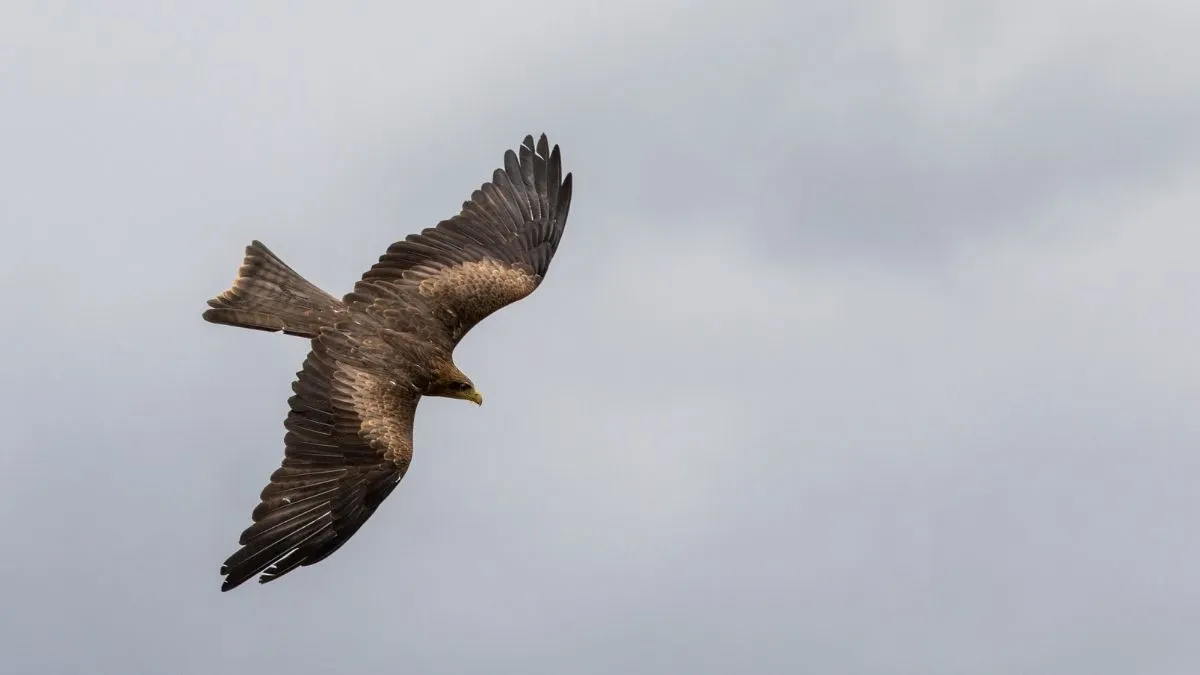
And then the exquisitely designed form comes into full view, flitting on the wind in an incredible display of acrobatic flight that would put even an Airlink pilot over a Cape Town rugby stadium to shame. The Yellow-Billed Kites have returned. Blessed be!

For me, they are the first true harbingers of spring: a sign that winter is fading and secret, unseen things are beginning to happen. Under the ground, sugar-rich nutrients are being pumped from roots into brown, bare shoots. Leaf buds lie in wait just below the surface of young bark, readying themselves to push through, unfurl and turn a dull, sleeping landscape into a green wonderland. Mycelium in the soil is preparing too, so that the first rains to soften the earth are accompanied by mysterious mushrooms - the fruiting bodies of the underground mycelial network that connects life beneath our feet - pushing through the rich soil, doing their work of spreading spores on the wind. Frogs are stirring in their winter burrows, preparing to wake and sing to us each summer night. And far overhead and still far away, rainclouds are forming, gathering and preparing to break the dry season's hold on the land.
Messengers on the wind
This time of year never ceases to astound and humble me. Nature is truly the most wonderful and magical thing, and the messengers that signal the start of this transformation have always been, for me, the Yellow-Billed Kites. They bring joy and green and blossoms and rain with them on the wind.
I will admit to breathing a sigh of relief when I see the local pair who nest every year in a tree on a neighbour's property. I think of them often during the long, cold winter and send well wishes their way, hoping that my whispered thoughts find them somewhere on the wind and keep them safe from harm. So many dangers lie in wait for migratory bird species that it gives me great comfort when I hear their calls and see them making swooping flights close to their nesting tree. Every year, I send a prayer of thanks up to Mother Nature for their return.

Aerial acrobats and survivors
These magnificent birds are part of a larger group of gifted aerial acrobats, with the ability to cut through the air, glide and hang almost motionless on the invisible currents above. Contrary to popular belief, the birds were not named after the children's toy; rather, the toy was named after these amazing birds and their ability to hover, dart and dive high above us.
They are intra-African migrants and remarkable predators, frequently found in mixed flocks with many other species at alate emergences, where they catch flying termites on the wing and feed with ease. Their diet is varied and includes insects, birds, mammals and reptiles, and they also scavenge on small carcasses. This scavenging behaviour puts them at risk, as they are often seen swooping over roads and highways to recover a dead rodent or bird. They can become victims of collisions with vehicles because of this. Their scavenging habits also make them vulnerable to poisoning, as they may eat a mouse or rat that has succumbed to rodenticide and sadly be poisoned themselves. As scavengers though, they play an integral role in keeping our environment clean and disease-free.
Even their name carries a little story of its own. The Yellow-Billed Kite has not always been easy for experts to place neatly on the family tree. Some have regarded it as a close relative, or subspecies, of the Black Kite (Milvus migrans), while others recognise it as a species in its own right (Milvus aegyptius). Yellow-Billed Kites in southern Africa are further thought to represent two distinct races, each with its own rhythm and route across the continent. One (the nominate race) does not breed in southern Africa, but arrives in loose, lively flocks alongside other migratory raptors, gathering to roost together as though sharing travel tales from the wind. The other (the parasitus race), the familiar southern African breeding race, is more often seen in devoted pairs. Together they build their nests, and while the female keeps the eggs warm, the male takes his turn at brooding duties too. When the chicks hatch, both parents share in the work of feeding them, a small domestic drama unfolding high in the branches, hidden among leaves and sky.
However it's labelled, the bird I wait for each August remains the same familiar presence in our skies: yellow-billed, dark-winged, effortless on the wind, and somehow always arriving with spring tucked beneath its wings.
Perhaps that is why the return of the Yellow-Billed Kites means so much to me. They are more than seasonal visitors: they are reminders that life is always preparing itself, even when the world appears bare and still. Their arrival carries the promise of warmth, rain, blossom and song, but also a quiet lesson in resilience. Each year, when I see them riding the invisible currents above, I am reminded to look up, to notice, and to trust that renewal is already on its way.
About the author - Maxine Gaines
Maxine is a passionate nature lover who completed an undergraduate degree majoring in zoology and botany. She then completed an honours degree in environmental science and a postgraduate Diploma in Higher Education.
She worked as a guide for 12 years in the Greater Kruger, Tanzania, Kenya and Maputaland. During this time, she mentored young guides and ran a guide training school. She still guides part time. She also taught high school science and biology for a few years, before returning to varsity to complete a Master of Science in Nature Conservation.
When not working or studying, she loves family time with her boys, curling up with a good book with her pack of unruly hounds at her feet, getting her hands dirty in her indigenous garden, and bird watching.