I recently was privileged to witness two remarkable alate emergences. At this time of year, however often I see one, I am compelled to stop and enjoy the spectacle in open-mouthed wonder! The air fills with wings, the ground comes alive and creatures I might otherwise miss gather for a feast. Both experiences left me marvelling—and looking more closely at the insects behind the excitement.
A banquet in Zululand
The first spectacular emergence of the season came a few weeks ago on a Zululand reserve. After heavy overnight rain, sunlight caught the wings of thousands of emerging termites, creating the illusion of a river of molten gold pouring from the ground. This protein- and fat-rich bounty attracted a mind-boggling variety of animals.
Warthogs fed at the emergence holes before the termites could fly away. A blue-headed tree agama stationed itself on one side of the termite mound, close to the action while opposite, a water monitor also lazily picked off termite bounty. A red duiker fed around the mound, but was it nibbling newly sprouted vegetation or joining the protein-rich feast? I could not tell, and that unanswered question made the scene all the more absorbing.
Above the mound, lilac-breasted rollers, cape starlings, a paradise flycatcher and a few little bee-eaters darted back and forth in a rainbow-coloured feeding frenzy. A slender mongoose shot from the thicket, grabbed a mouthful of termites and retreated to cover as a Wahlberg’s eagle swooped overhead, also feeding on the termites. A pair of aerial acrobats in the form of yellow-billed kites completed the feeding gathering I saw on this occasion.
What is all this fluttering about?
Why do all those winged insects appear together?
Alates are winged ants and termites that leave their nests in enormous, synchronised nuptial flights to mate and start new colonies. Known as “flying ant day” or “flying termite season”, the spectacle is a carefully timed opportunity to find mates and survive hungry predators.
The rain before my Zululand encounter was a clue. Colonies wait for warmth, high humidity and low wind, often just after a heavy rainstorm. Rain also softens the soil for new queens to dig underground.
There is safety in numbers. Birds, spiders, frogs and bats feast on alates, but thousands—sometimes millions—launching together swamp predators, allowing enough queens to survive and reproduce. The busy termite mound I watched, made it easy to appreciate why numbers matter.
Synchronised timing also mixes the gene pool: neighbouring colonies of the same species respond to the same weather cues, bringing males and females from different nests together to mate.
Durban’s turn to put on a show
The second emergence transformed suburban Durban into a stage for an equally impressive spectacle, with a different cast of animals.
Vervet monkeys made acrobatic jumps to catch termites in mid-air as yellow-billed kites and steppe buzzards swooped overhead. Then—oh, joy!—a peregrine falcon appeared, long narrow wings powering impressively fast flight, catching alates in its talons and transferring them to its beak in flight.
Colourful violet-backed starlings joined black flycatchers, fork-tailed drongos, village weavers, grey-headed sparrows and black-headed orioles. Most surprising was a black-headed heron, which spent quite some time soaring low and banking very slowly, making me wonder if he was indeed eyeing out the termites or just passing by. He landed at the main emergence site, eating a few termites before being startled by passing traffic departing skywards as slowly and gracefully as he arrived. A fat guttural toad who was sluggishly moving around the holes in the ground from where the termites were emerging (numerous termite wings sticking out at odd angles from the corners of his mouth), was probably very relieved to see him go!
Palm swifts, with long, narrow tails and streamlined bodies, filled the air around my head. Would the peregrine turn from termites to the smaller birds distracted by the feast? I did not see it happen, but what a scene to watch!
Unexpected diners at nature’s table
The warthogs in Zululand and raptors over Durban showed how alate emergences attract more than the usual insect-eaters. Slow-flying, defenceless and rich in fat and protein, alates offer an easy meal even to animals that normally hunt larger prey such as mammals, birds and fish. On the African savanna, black-backed jackals have been observed snapping up swarming termites from the ground and air. Small carnivores such as banded mongooses abandon their usual foraging routines to gorge on fat-rich alates during wet-season emergences. In North America, black and grizzly bears seek swarming ant colonies, licking thousands of winged ants from rocks and logs to build fat reserves before hibernation. Like the Zululand diners, they gain plentiful food for little effort.
Large raptors that usually hunt rodents, snakes or fish—including African fish eagles and steppe buzzards—join swallows and swifts in mid-air feeding frenzies, while Steppe Eagles and Lesser Spotted Eagles can be seen in large numbers perched low or on the ground during summer alate emergences in places like the Greater Kruger Park.
After dark, smaller raptors such as pearl-spotted owlets and barn owls use moonlight or streetlights to pick off slow-moving termite alates. Bats are known to enjoy termites emerging after dark and nocturnal bushbabies (galagos) have been recorded feasting on them too.
Woodland kingfishers and hornbills, more usually occupied with lizards or large ground insects, also hawk flying termites—sometimes clumsily—during heavy emergences. Near rivers, dams and lakes, thousands of exhausted alates can crash-land on the water, triggering feeding frenzies among trout, bass and tilapia. Fly-fishermen imitate these events with “flying ant” lures.
Certain burrowing reptiles, such as Western blind snakes, live inside or beside ant and termite nests, ambushing soft-bodied alates in underground tunnels before they reach the surface. While soldier termites guard emergence holes, army ants and driver ants may launch coordinated raids at the exit tunnels, dragging newly emerged alates back to their nests before take-off adding even more drama beneath the fluttering wings.
Flying ant or flying termite?
Both my encounters involved termites, though “flying ants” and “flying termites” are often treated as the same thing. A closer look reveals useful differences.
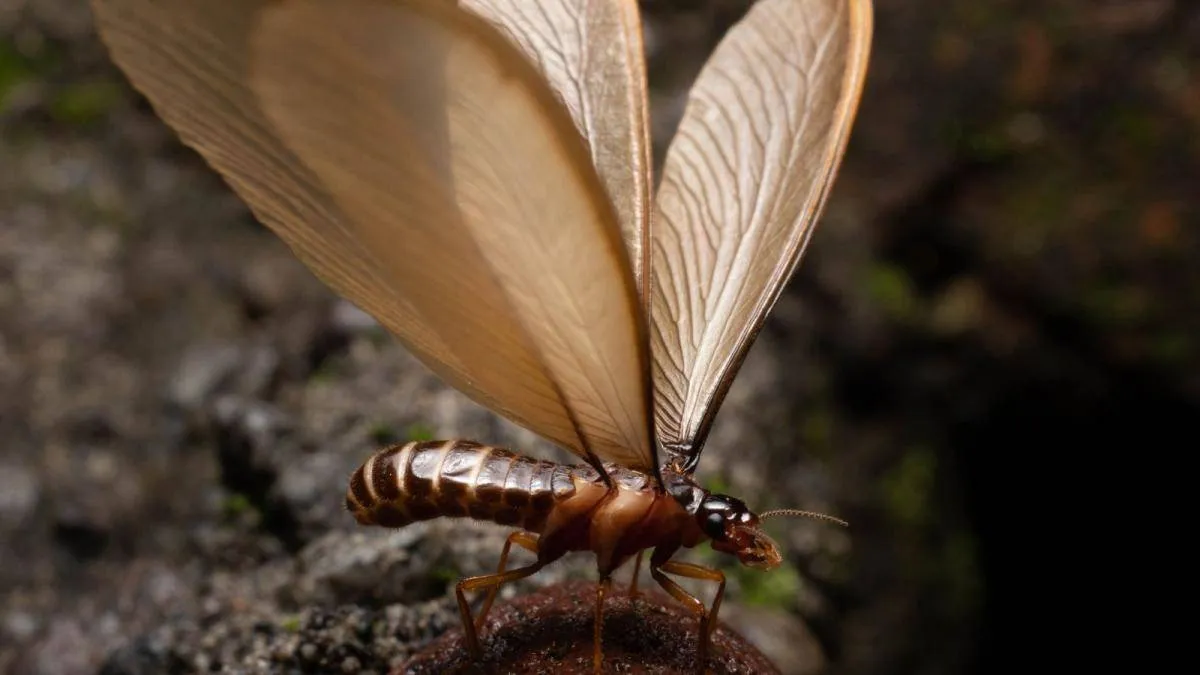
Wings: ant alates have two pairs, the front pair noticeably larger than the back. Termite alates have four equal-sized wings, much longer than their bodies.
Waist and antennae: flying ants have pinched, narrow waists and bent, elbowed antennae; flying termites have thick, uniform waists and straight, bead-like antennae.
Discarded wings: fragile termite wings break off easily, often leaving piles near windowsills or outdoor lights. Ant queens also shed their wings after mating, usually pulling or chewing them off after landing, as the next stage of colony life begins.
More than meets the eye
A few more details make alate flights even more fascinating.
Some emergences are dense enough to appear on weather radar as false rain clouds: meteorologists occasionally mistake huge flying-ant swarms for localised precipitation.
For alates, this is the great, one-time flight after an adult life underground. Once a queen lands and sheds her wings, her flight muscles break down, nourishing her first batch of eggs as she begins a new colony.
People also share the bounty. In many parts of the world, including Southern Africa, termite alates—locally known as izinlhwa or amadlwa in isiZulu—are harvested around lights at night and traditionally roasted or fried as a nutritious, protein-rich snack.
A reason to stop and look
From the Zululand reserve’s termite mound, with warthogs, reptiles and a darting mongoose beneath colourful birds, to suburban Durban’s acrobatic monkeys, peregrine and heron startled by traffic, these two emergences left me marvelling. Different settings and diners shared the same extraordinary burst of life, driven by weather cues, the search for mates and safety in overwhelming numbers as new colonies begin. Every year, the spectacle reminds me that we need not travel far to seek out nature’s wonders: sometimes they are already around us, asking only that we stop and look.
References
Wild Tomorrow. The nuptial flight of the termite. A KwaZulu-Natal account covering weather-related emergence, colony reproduction and feeding by birds and other wildlife. Relevant to “What is all this fluttering about?” and “An invitation almost nobody turns down”.
Hendry, L. Natural History Museum. Flying ant day: When winged ants take their nuptial flight. Explains ant alates, weather cues, mating between colonies and swarming as protection from predators. Its seasonal examples refer to Britain rather than South Africa.
University of Hawaiʻi at Mānoa, UH Termite Project. Alate Project: Identification Guide. Describes the differences in wings, antennae and waist shape between winged ants and termites. Relevant to “Flying ant or flying termite?”.
Met Office Press Office (2 July 2025). Met Office Deep Dive: Record heat, flying ants, and a changeable outlook. The “Flying ants on the radar” section documents ant swarms producing radar echoes resembling showers. Relevant to the radar example in “More than meets the eye”.
Fombong, F. T. and Kinyuru, J. N. (2018). Termites as Food in Africa. In Termites and Sustainable Management, Chapter 11. Reviews termite consumption in sub-Saharan Africa, rainy-season harvesting, attraction to lamps and nutritional composition. Relevant to the human consumption paragraph in “More than meets the eye”.
Hlongwane, Z. T., Siwela, M., Slotow, R. and Munyai, T. C. Effect of geographical location, insect type and cooking method on the nutritional composition of insects consumed in South Africa. Journal of Insects as Food and Feed, 8(5), 537–556. DOI: 10.3920/JIFF2021.0067. A South African study including termite alates from Limpopo; useful support for the discussion of their nutritional value.